Featured Post

Never Waste a Crisis!

Now is a good time for progressives to think about what we should encourage and what we should resist during the current crisis and in the...

Showing posts with label lockdown. Show all posts

06 May 2020

COVID-19 and 'The Wretched of the Earth'

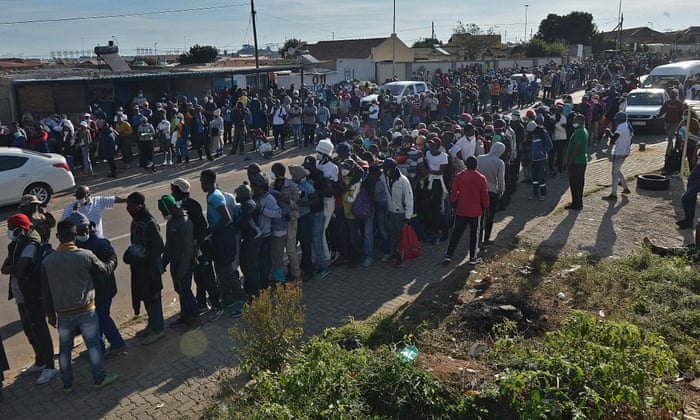
This photo shows a small part of a four kilometre long queue for food parcels in a township outside Pretoria, South Africa! (and see video). Lockdown looks very different depending on where one stands.  

Is this the experience of most of the world's population?   

Is this an inevitable outcome of treating COVID-19 mainly as a health problem rather than a whole-of-society problem?

Will we be surprised if the Wretched of the Earth bite back?

People line up to receive food handouts in the Olievenhoutbos township of Midrand


30 April 2020

Requisitioning our homes?

Many white-collar and 'knowledge workers' are currently working from home.  In this guest post Dr. Fiona Jenkins, Associate Professor of Philosophy and Convenor of the Gender Institute at the Australian National University (ANU), ponders the implications of being required by our employers to make our homes into our offices.*

Working from home is usually thought of as a privilege - like flexible work, it's most often considered as an enlightened gift of the employer rather than as a right of the employee. How do things change when working from home is made a requirement by the employer, in order to comply with the dual exigency of a government-imposed lockdown in response to a global pandemic, and the need to keep business running?

Suppose we say that what we have actually just done by closing down workplaces and substituting "working from home" is in effect a requisition of people's homes as their place of work. This is not implausible. To requisition is to demand the supply of something by official order. It happens typically in times of emergency.

We have all been required to work from home, which means we have all been required to supply the equivalent of office space for our work.

These homes become offices with varying degrees of ease. While some have well-set-up home offices already, others are trying to set up a desk in the bedroom, or to work out time-share on the dining table, which is the only table in the house. While some occupy the home alone or with a compatible fellow adult, for others it's a much less easy space. 

These differences become salient to terms of employment when there is no option but to work from home. One important way in which we are smoothing over such issues is by borrowing language from the equity lexicon that meant one thing when we were in normal circumstances, but means quite another now that we are in an emergency context. Take "flexible working arrangements", for example. Normally these imply the opportunity for movement between home and the office; and they imply negotiation to fit one set of demands with another. Now, in this crisis, a new set of powerful exigencies rules. There is no more movement. There is only home - which in the course of a few very intense weeks, has become rather un-homely.

Flexibility now means "just make this work!". The people who usually do the most work on "flexibility" - women - are very likely doing the most work on this right now too. Although many employers are certainly being supportive, let's not forget that those who until recently took their homes for private space are not gaining a privilege right now, but losing a set of prerogatives. We are paying a price for safety in a time of crisis that could not be reasonably exhorted in normal times. We should remember that when normality returns, lest the terms of crisis management themselves are normalised, as often happens.

So "working from home" at present means something like this: employers have requisitioned the home as a condition of continuing to work, and they have taken away the office as part of what was previously offered to enable people to work. Although this new circumstance clearly should change what "flexibility" is understood to be about, we are using the same word in changed contexts, in part as a way to manage a sense of continuity and recalibrate expectations. We are talking about "working from home" as if it were continuous with what it previously meant as an optional alternative to "working in the office".

In the present crisis, policymakers are mostly quite unreflective about this core pillar of our mitigation strategy - perhaps because they are used to taking the home for granted and to imagining it in a certain way. Acting as if home is a costless resource that is free for appropriation in an emergency, ignoring how home functions as a site of relatively invisible gendered relations of care and labour and imagining home as a largely frictionless site of interpersonal relations, come all too naturally, especially in a crisis.

This has to change, and urgently, because while this pillar of our strategy for containing COVID-19 is essential, it is also fragile. We must avoid taking this resource for granted and recall some "home truths". These include that for women, home remains one of the greatest reserves of inequality. Every statistic points to the disparities in average burdens of care in the household. Every trigger we know for domestic violence is currently intensifying. Workplace flexibility is supposed to mean accommodating work/life balance; in practice it still often means meeting deadlines by breastfeeding a baby at your desk while you park your six-year-old in front of Netflix. It is clear that latter version of "flexibility" is just not sustainable as a way of managing this time of crisis, but it is what many are resorting to now. There are other crises than COVID-19 brewing in this mix.

My own employer, the Australian National University, has made helpful and impressive allowances for the new situation we find ourselves in by specifying that where people are faced with complex situations working from home, 25 hours per week will be deemed a full-time load (and pro rata for part-time). This gives clarity on what full-time now means, and the offer seems considered and generous. But if you then think of the relative costs of working from home - imposed in differential ways depending on people's particular circumstances in the asset being requisitioned - perceptions may shift.

For example, compare my situation as someone with a good salary and a home office, with someone on the lower levels of the administrative scale who has a two-bedroom townhouse. She has a child who just began school this year and a partner also working from home. Her (their) working space is the dining table. She is worried about the costs of heating if she has to be at home in the winter. The employer won't pay for extra internet access - it's got to come from her tax claim as a "home office" expense (ironically, given the dining table). She's on four days a week and although she and her partner are trying to share care by tag-teaming in this small space, she's very worried about how she's even going to manage 20 hours.

The university just requisitioned her space when it mandated working from home. Would saying things this way help us to see that we might be doing more to systemically even out the burden imposed on her and the burden imposed on me? At present, the promise is that such situations will be reviewed on an individual basis. But seeing requisition as imposing unequal burdens suggests the onus might lie with employers to elaborate some principles about enabling all to work from home while distributing the cost that imposes more evenly. We might also consider whether what is on offer here is enough flexibility on the employer's part to compensate for the "flexibility" now being imposed on the employee. In effect, trading up to two hours a working day against all the other expenses of taking work into an under-equipped home is perhaps not quite as generous toward certain people as it might seem at first.

While I am completely behind the move to lockdown, and grateful to have an employer carefully addressing the issues so that we can maintain our core work, I worry that caught up in the urgency of crisis we risk forgetting just how problematic the "working from home" pillar of our strategy for mitigation is in multiple respects. Just because we accept the necessity of action in the context of emergency should not mean that we do not question its further implications and its practice. Others indeed may be suffering much more in this crisis than those lucky enough to continue to work from home - but that does not mean we should ignore how this work's burdens are distributed. Perhaps if we use the language of "requisitioning" we can see why it would not be too much of an exaggeration to say that many people feel they have just lost their homes as a result of our move to "working from home".

* This article was previously published in the Canberra Times

24 April 2020

Is the lockdown in Melbourne evaporating?

Is it just my imagination or is the lockdown in Melbourne evaporating even before it has been officially lifted?

There's a notable increase of people on the streets and a number of small shops are re-opening.  The local Coles supermarket is getting visibly busier.  And there are many more cars on the road than a week ago.  Some homeless people are back on the streets begging.  Parks are much fuller than they were two weeks ago.

I needed a haircut after making a total mess of cutting my own hair, and found a salon around the corner that had re-opened!  There is no law against them doing so but a few weeks back every hairdresser shut their doors.  This one was using the JobKeeper subsidy to keep their Australian staff at home and on the payroll, but getting the non-Australian staff, ineligible for assistance, to do the work.

Certainly, in all these instances, people were making some effort not to congregate and some distancing measures are in place going into shops, although in practice 1.5 meter gaps are really not practicable - the supermarket aisles aren't that wide and so people inevitably pass more closely than is recommended.

What are the implications of de facto lifting the lockdown before government advises it?  Does it undermine state authority?  Or is the state government turning a blind eye because the current infection rate and death rate is pretty low?

The state of Victoria has a population of 6.28 million, two-thirds of whom live in Melbourne.  According to the state government, as of 24 April 2020, the total number of coronavirus cases in Victoria was 1,343, including 6 new cases yesterday.  These are mainly people who have returned from abroad.  27 people are in hospital, including 11 people in intensive care. 16 people have died.

11 April 2020

Lockdowns and why one size doesn't fit all

Much of the COVID-19 press coverage has focussed on the difference between lockdown strategies in various countries.  Less attention has been paid to whether lockdowns are the appropriate dominant strategy.

Lockdowns in the global South are manageable for the rich and even the middle class.  Many in Delhi, for example, are also barricading the so-called 'colonies', areas where the wealthier citizens live, to keep people out (at least barricading them more than they already do).

But lockdowns are not workable for the majority of the urban population where there are often many people sharing a room, where access to a tap may involve a walk to the shared standpipe, where there is not enough money even to stock up on supplies for a week, let alone think about buying internet bandwidth or a Netflix subscription.  In such an environment a lockdown is neither sustainable nor just.

Enforcing lockdowns in such a context becomes war on the poor.

Read this account from South Africa by a journalist visiting Masiphumelele, a township to the South of Cape Town.

Or this one looking at the dense low-income settlements (often called 'slums') in Mumbai, India.

Dharavi, Mumbai


02 April 2020

COVID Justice: Is the lockdown strategy the right one for all countries?

In many 'developing', countries the lockdown strategy seems to be taking the form of war on the poor, in the interests of the wealthy and the urban, 'modern' middle-class, and with the aim of protecting them from infection by the poor.  I say this reluctantly as I know the governments of these countries are stuck between a rock and a hard place and they have no easy options available.

I get the epidemiological case for lockdowns.  Cut the number of physical interactions sharply, encourage hand-washing, surface cleaning, face masks etc, and the rate of increase of COVID-19 can be slowed down.  This, in turn, can ease pressure on hospitals (Italy certainly needs that) and make space for more proactive test, trace, track and quarantine strategies.

Singapore, and to a lesser extent South Korea, are rare exceptions to the lockdown focus.  As I understand it, they have highly effective test, trace, track and quarantine programmes without having adopted a generalised lockdown.  Their schools and businesses largely remain open, although not their borders, and the pandemic is largely being managed.

Australia, like much of Western Europe, has locked down to a significant extent with more on the way.  It is too early to say if this strategy is working.  Even so, the partial lockdown implemented has come at a massive cost to jobs, livelihoods and the national budget.  To save the system, the centre-right government has in part suspended capitalism in order to save it.  The government's expressed aim is to hibernate the system and return to business-as-usual once the virus is under control.  It has committed about A$300 billion, and rising daily, in the space over little over a week, to various safety net measures antithetical to its neoliberal stance.  These measures include bailouts and loans for business, the state guaranteeing a proportion of the salaries of all private sector employees, the de facto incorporation of the private hospitals into the public health system, a doubling of unemployment benefits and making these much easier to claim, free childcare provision, and so on.  New measures are announced daily!

Australia is, generally speaking, a rich country with a sophisticated public health system and a healthy public balance sheet.  Most of its citizens live a modern, middle-class consumer existence.  Even so, the effects of the lockdown are felt more harshly by some than by others: the homeless, remote indigenous communities, those in irregular and casual employment, families in small or crowded accommodation, those unable to homeschool their children, families with limited savings and assets, non-citizens, backpackers, tourists unable to return home, and more.

By contrast, the lockdown picture in developing countries is very different, and already highly disturbing.  The regulations and their enforcement make it relatively easy for the better-off to stockpile supplies, shut their doors and watch Netflix, whilst the majority carry the real burden of the lockdown.  In India, a nation of over 1.3 billion people, early accounts show devastation for the poor - for example here, here and here.  Little by way of food and support is available.  Many have effectively been driven from the cities, and police actions have often been unnecessarily harsh and inhumane.  On a positive note, some states (such as Kerala) seem to be avoiding some of these problems.  Stories of apartheid-style enforcement and repression are emerging elsewhere, such as in The Philippines.

In South Africa, a similar pattern is already evident.  A strict lockdown is being enforced by police and the military, with numerous abuses of power already evident.  Here's a video I received from a friend a couple of days back. The viewer should know that the lockdown includes a ban on alcohol sales.  It is not clear if the person in the video is drinking a beer of his own (allowed) or selling beer (forbidden).  Whatever the case, a 'people versus the authorities' dynamic is evident.  This is not an isolated example (see here) although it is still unclear how widespread such police/military actions are.


The South African state has little capacity to provide significant additional support, such as food, to the poorest citizens, although its existing social security grant system is extensive, albeit modest.  Its fiscal condition is weak - the ratings agencies downgraded the country's credit-worthiness to junk bond status this week meaning a capital flow from the country to the rich world at this moment of crisis.

Structurally, a lockdown doesn't make sense for the majority of South Africans, even as it makes sense for the wealthier citizens.  Apartheid-era spatial divisions persist and the rich (of all races) have erected high walls around their enclaves.  The lockdown intensifies this division. There is no public transport system to speak of:  the minicab taxi system which the poor depend upon relies on the sort of over-crowding and cost models which are incompatible with physical distancing.  Street traders who make and sell food at the roadside have been shut down, as have Somali and other foreign-owned small township 'spaza' shops (xenophobia by police in interpreting the regulations is reportedly widespread).  The poorest citizens have to make their way to the large supermarket chains which are more expensive and have had their shelves emptied by wealthier stockpilers.  Housing is crowded, many people to one room, and many have no access to taps and soap for regular hand washing.  One could go on.  The lockdown will only be enforceable with extreme violence and at high human cost.  And South Africans are not passive in the face of repression.

Here's an excellent analysis, by a well-respected NGO, examining the South African lockdown through the prism of food availability.  The lockdown has revealed the societal divisions and exacerbated them, even though there are pockets of hope in the Collective Action Networks (CAN) which some have set up, and the work of some charitable organisations.

Nigeria, a country of over 200 million people, and only days into a lockdown, finds ordinary citizens complaining it is impossible to comply and food is scarce.

It is probably too soon to be definite, but there seem to be a number of different strategies emerging internationally for tackling COVID-19.  Four broad strategies are evident so far.  Of course, this crude and hasty typology is very tentative and will also be dependent on the leadership given by each country's rulers.  And there are strategies, not covered here (Brazil and Sweden spring to mind).  But here's my first bite at understanding the range of strategies:

  1. There are those with pandemic experience and advanced healthcare systems, which have gone hard and gone early and gone autocratically.  They seem to be succeeding in getting the virus under control.  Mainly these are East Asian countries.
  2. There are those with little pandemic experience, which have gone hard but belatedly and with massive state support for their citizens facing rent and income stress and at great economic cost.  They are not yet succeeding in controlling the virus.  These are mainly the rich European countries. The USA seems to be shuffling in this direction.
  3. There are the middle-range developing countries trying to go hard and using lockdowns.  Their deep-rooted social inequality places an unreasonable burden on the poor.  It is hard to see how they will succeed, although they may manage wealthy critically-ill citizens.  Hard too to see why popular discontent might not erupt.  Here we should expect that COVID-19 will work its way through the society, at great cost to human life amongst the poor, until so-called 'herd immunity' is reached (or a vaccine arrives soon).
  4. Finally, it will be important to watch those poorer countries with experience of deadly pandemics, such as in parts of West Africa.

Developing countries adopting lockdown approaches will soon find these turn into war against the poorest.  I hope I am wrong about this.

[UPDATE: After this was written South Africa relaxed some of the lockdown rules, and disciplinary action has been taken against some police officers.]