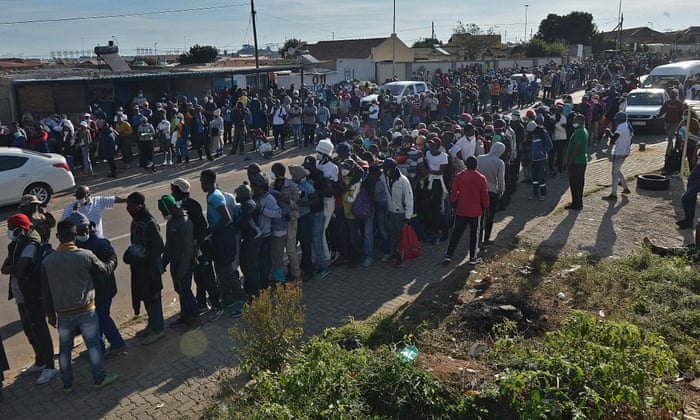
In many 'developing', countries the lockdown strategy seems to be taking the form of
war on the poor, in the interests of the wealthy and the urban, 'modern' middle-class, and with the aim of protecting them from infection by the poor. I say this reluctantly as I know the governments of these countries are stuck between a rock and a hard place and they have no easy options available.
I get the epidemiological case for lockdowns. Cut the number of physical interactions sharply, encourage hand-washing, surface cleaning, face masks etc, and the rate of increase of COVID-19 can be slowed down. This, in turn, can ease pressure on hospitals (Italy certainly needs that) and make space for more proactive test, trace, track and quarantine strategies.
Singapore, and to a lesser extent South Korea, are rare exceptions to the lockdown focus. As I understand it, they have highly effective test, trace, track and quarantine programmes
without having adopted a generalised lockdown. Their schools and businesses largely remain open, although not their borders, and the pandemic is largely being managed.
Australia, like much of Western Europe, has locked down to a significant extent with more on the way. It is too early to say if this strategy is working. Even so, the partial lockdown implemented has come at a massive cost to jobs, livelihoods and the national budget. To save the system, the centre-right government has in part
suspended capitalism in order to save it. The government's expressed aim is to hibernate the system and return to business-as-usual once the virus is under control. It has committed about A$300 billion, and rising daily, in the space over little over a week, to various safety net measures antithetical to its neoliberal stance. These measures include bailouts and loans for business, the state guaranteeing a proportion of the salaries of all private sector employees, the
de facto incorporation of the private hospitals into the public health system, a doubling of unemployment benefits and making these much easier to claim, free childcare provision, and so on. New measures are announced daily!
Australia is, generally speaking, a rich country with a sophisticated public health system and a healthy public balance sheet. Most of its citizens live a modern, middle-class consumer existence. Even so, the effects of the lockdown are felt more harshly by some than by others: the homeless, remote indigenous communities, those in irregular and casual employment, families in small or crowded accommodation, those unable to homeschool their children, families with limited savings and assets, non-citizens, backpackers, tourists unable to return home, and more.
By contrast, the lockdown picture in developing countries is very different, and already highly disturbing. The regulations and their enforcement make it relatively easy for the better-off to stockpile supplies, shut their doors and watch Netflix, whilst the majority carry the real burden of the lockdown. In
India, a nation of over 1.3 billion people, early accounts show devastation for the poor - for example
here,
here and
here. Little by way of food and support is available. Many have effectively been driven from the cities, and police actions have often been unnecessarily harsh and inhumane. On a positive note, some states (such as Kerala) seem to be avoiding some of these problems. Stories of apartheid-style enforcement and repression are emerging elsewhere, such as in
The Philippines.
In
South Africa, a similar pattern is already evident. A strict lockdown is being enforced by police and the military, with numerous abuses of power already evident. Here's a video I received from a friend a couple of days back. The viewer should know that the lockdown includes a ban on alcohol sales. It is not clear if the person in the video is drinking a beer of his own (allowed) or selling beer (forbidden). Whatever the case, a 'people versus the authorities' dynamic is evident. This is not an isolated example (see
here) although it is still unclear how widespread such police/military actions are.
The South African state has little capacity to provide significant additional support, such as food, to the poorest citizens, although its existing social security grant system is extensive, albeit modest. Its fiscal condition is weak - the ratings agencies downgraded the country's credit-worthiness to junk bond status this week meaning a capital flow from the country to the rich world at this moment of crisis.
Structurally, a lockdown doesn't make sense for the majority of South Africans, even as it makes sense for the wealthier citizens. Apartheid-era spatial divisions persist and the rich (of all races) have erected high walls around their enclaves. The lockdown intensifies this division. There is no public transport system to speak of: the minicab taxi system which the poor depend upon relies on the sort of over-crowding and cost models which are incompatible with physical distancing. Street traders who make and sell food at the roadside have been shut down, as have Somali and other foreign-owned small township 'spaza' shops (xenophobia by police in interpreting the regulations is reportedly widespread). The poorest citizens have to make their way to the large supermarket chains which are more expensive and have had their shelves emptied by wealthier stockpilers. Housing is crowded, many people to one room, and many have no access to taps and soap for regular hand washing. One could go on. The lockdown will only be enforceable with extreme violence and at high human cost. And South Africans are not passive in the face of repression.
Here's an
excellent analysis, by a well-respected NGO, examining the South African lockdown through the prism of food availability. The lockdown has
revealed the societal divisions and exacerbated them, even though there are pockets of hope in the
Collective Action Networks (CAN) which some have set up, and the work of some
charitable organisations.
Nigeria, a country of over 200 million people, and only days into a lockdown, finds ordinary citizens complaining it is impossible to comply and
food is scarce.
It is probably too soon to be definite, but there seem to be a number of different strategies emerging internationally for tackling COVID-19. Four broad strategies are evident so far. Of course, this crude and hasty typology is very tentative and will also be dependent on the leadership given by each country's rulers. And there are strategies, not covered here (Brazil and Sweden spring to mind). But here's my first bite at understanding the range of strategies:
- There are those with pandemic experience and advanced healthcare systems, which have gone hard and gone early and gone autocratically. They seem to be succeeding in getting the virus under control. Mainly these are East Asian countries.
- There are those with little pandemic experience, which have gone hard but belatedly and with massive state support for their citizens facing rent and income stress and at great economic cost. They are not yet succeeding in controlling the virus. These are mainly the rich European countries. The USA seems to be shuffling in this direction.
- There are the middle-range developing countries trying to go hard and using lockdowns. Their deep-rooted social inequality places an unreasonable burden on the poor. It is hard to see how they will succeed, although they may manage wealthy critically-ill citizens. Hard too to see why popular discontent might not erupt. Here we should expect that COVID-19 will work its way through the society, at great cost to human life amongst the poor, until so-called 'herd immunity' is reached (or a vaccine arrives soon).
- Finally, it will be important to watch those poorer countries with experience of deadly pandemics, such as in parts of West Africa.
Developing countries adopting lockdown approaches will soon find these turn into war against the poorest. I hope I am wrong about this.
[
UPDATE: After this was written South Africa
relaxed some of the lockdown rules, and
disciplinary action has been taken against some police officers.]